When Animals Become Guardian Angels: Two Miraculous Stories of Survival and the Unbreakable Bonds That Saved Lives
When Animals Become Guardian Angels: Two Miraculous Stories of Survival and the Unbreakable Bonds That Saved Lives
There are moments when the line between the explainable and the miraculous blurs so completely that we’re left standing in awe, wondering if what we’re witnessing is even possible. Two extraordinary stories—one involving a lost child and wild wolves, the other a police dog’s mysterious refusal—remind us that sometimes the most profound acts of protection come from creatures we’ve underestimated for far too long.
A Family Hike Turns Into Every Parent’s Nightmare
The morning started like any other weekend adventure. A family of three ventured into the forest’s embrace, seeking that peaceful escape from the noise of everyday life. Their nine-year-old son, diagnosed with autism, walked slightly ahead, his face lit up with the kind of pure curiosity that only children possess. The forest was his favorite place, filled with creatures he’d studied obsessively—particularly wolves.


His bedroom back home told the story of his fascination: walls plastered with wolf posters, bookshelves overflowing with volumes about pack dynamics, loyalty, and the quiet dignity these misunderstood animals possess. To him, wolves weren’t the villains from fairy tales. They were family-oriented, intelligent, and graceful beyond measure.
But forests have a way of swallowing people whole when attention wavers for just a moment. As the trees grew denser and shadows lengthened across the trail, the boy drifted away. One wrong turn at a fork in the path. One moment where his parents glanced at their map instead of at him. And suddenly, he was gone.
The panic that followed was the kind that turns your blood to ice. His parents’ voices grew hoarse from calling his name into the void. Within hours, volunteers flooded the area—rangers with decades of experience, search dogs trained to find the faintest scent, locals who knew these woods like the back of their hands. Flashlights carved paths through the darkness all night long, but the forest kept its secret.
The boy never responded to their calls. The temperature dropped. Every parent’s most visceral fear began materializing in the suffocating silence between the trees.
Dawn Brings an Impossible Answer
When the sun finally broke through the canopy at sunrise, exhausted searchers prepared for another grueling day. Then, like something out of a dream, the boy emerged from an overgrown game trail near the tree line. Muddy. Exhausted. But completely, miraculously unharmed.
His mother collapsed to her knees and pulled him close, tears streaming freely. Through her sobs, she managed to ask the question everyone needed answered: “How did you find your way back?”
The boy’s response was matter-of-fact, delivered with the calm certainty of someone stating an obvious truth. “The wolves guided me.”
The adults exchanged glances—relieved smiles mixed with gentle skepticism. Of course, they thought. A frightened child’s imagination had created a comforting narrative to process the terror of being lost and alone in the dark. The mind does remarkable things to protect itself, especially a young mind trying to make sense of overwhelming fear.
But something about his unwavering certainty made them pause. He wasn’t telling a story. He was recounting what happened.
When Skepticism Meets Undeniable Truth
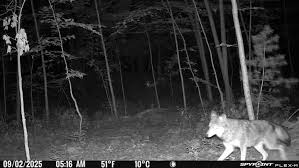
A week passed. The family tried returning to normal life, grateful beyond words to have their son back safely. Then a local hunter, routinely checking footage from his game camera positioned deep in the forest, saw something that stopped his heart.
There, captured in grainy but unmistakable detail, was the boy. He was walking carefully along a narrow trail, clearly trying to find his way. But he wasn’t alone. Two wolves flanked him—one leading several paces ahead, the other trailing behind in a protective stance. Their movements weren’t random or predatory. They were deliberate, purposeful, coordinated.
The wolves were guiding him.
When the footage was shown to the boy, he didn’t react with surprise or excitement. He simply nodded with recognition. “That’s them,” he confirmed, pointing at the screen. “They showed me which paths to take when it got too dark to see clearly.”
His mother’s response carried the weight of a truth she’d known all along. Tears filled her eyes as she spoke. “My son has always had this connection with animals that I can’t fully explain. Other people might not have believed him, but I did. From the very first moment he told us, I believed him.”
Science Struggles to Explain What the Heart Already Knows
The wildlife biology community responded with a mixture of astonishment and cautious analysis. Wolves are notoriously wary of human presence, often detecting and avoiding people from remarkable distances. They’re not the savage beasts of folklore, but they’re also not typically inclined to approach humans—much less accompany a lost child through miles of forest terrain.
Dr. Peter Lang, a respected wildlife biologist, called the incident “extraordinary but not impossible,” choosing his words carefully. “Wolves possess incredibly complex social behaviors that we’re still working to fully understand,” he explained. “They’re capable of recognizing distress signals across species—crying, fearful body language, signs of vulnerability. It’s entirely possible these wolves perceived this boy as vulnerable and, operating on instincts we don’t fully comprehend, chose to protect him.”
He paused before adding what seemed to be the most important observation: “What we’re seeing in this footage isn’t aggression or mere curiosity. If I had to name it, I’d call it empathy.”
The boy’s parents have their own theory, one that transcends scientific explanation. They believe what happened was built on connection—something wordless and pure that exists beyond our typical understanding of interspecies communication. “He’s always felt this pull toward wolves,” his mother shared. “When he was younger, he used to tell me he could ‘feel’ them when the moon was full. At the time, I thought it was just a child’s imagination. Now I wonder if maybe they felt him too.”
A Story That Resonates Across the Globe
Since news of the incident spread, people worldwide have been deeply moved by what it represents. Here was a child who often struggles to connect with other people, who processes the world differently than most, finding understanding and protection in the wild. The bond captured in those few blurry camera frames became something larger than one miraculous night—it became a living symbol of how compassion and connection transcend language, species boundaries, and our limited human understanding.
The search-and-rescue team returned to the area weeks later out of curiosity. They found no fresh wolf tracks. No sightings were reported. The wolves had seemingly vanished back into the forest depths, returning to whatever lives they lead in the shadows beyond human observation.
But locals swear that on certain calm nights, when the wind carries just right through the trees, you can hear distant howls—not menacing or threatening, but soft and melodic, rising and falling like an ancient lullaby sung to the forest itself.
When asked what stands out most in his memory of that night, the boy’s answer was immediate and unshakeable. “They weren’t scary at all,” he said with absolute conviction. “They were kind. They waited whenever I got too tired to keep walking. They wanted me to find my way home.”
Perhaps that’s the most profound lesson the wolves left behind—that even in the wildest, most untamed corners of our world, compassion exists quietly, watching over those who need it most.
When a Dog’s Refusal Becomes a Life-Saving Command
The bond between handler and K9 partner is something civilians rarely understand fully. It’s built on trust that goes deeper than words, instinct that operates faster than conscious thought, and a wordless understanding that can literally mean the difference between coming home at the end of a shift or not coming home at all. One police officer learned this truth in the most dramatic way possible when his partner, a German Shepherd named Bravo, refused to get into their patrol car—a moment of stubborn resistance that turned out to be an act of profound courage.
Bravo isn’t the hesitant type. Anyone who’s worked with him knows he’s typically the first one in the cruiser each morning, practically vibrating with eagerness for whatever the day might bring. The routine is sacred: vest strapped on, check. Seatbelt secured, check. The familiar rumble of the engine and the anticipation of the road ahead—these were Bravo’s favorite moments, signaling another day doing what he was born to do, another day at his handler’s side.
But this particular morning shattered the routine completely.
The Refusal That Changed Everything
When the officer opened the cruiser door as usual, Bravo didn’t move. He wasn’t cowering or showing signs of illness. He wasn’t distracted by something in the distance. He simply sat down—deliberately, decisively—his intelligent eyes locked on the vehicle with an intensity that was impossible to ignore.
His handler gave the command they’d practiced thousands of times: “Bravo, up.”
Nothing. Not even a twitch.
“Come on, partner,” the officer urged, now confused, tapping the seat encouragingly. But Bravo remained frozen in place. For a dog who’d charged into burning buildings without hesitation, who’d tracked dangerous suspects through treacherous swamps, who’d once dragged his wounded handler to safety when communications failed—this quiet, absolute refusal was completely unprecedented.
Then it happened: a single, sharp bark that echoed through the garage. It wasn’t a bark of fear or confusion. It was a warning. A deliberate communication that something was catastrophically wrong.
In that instant, the officer’s confusion transformed into dread. He knew his partner too well to dismiss this behavior. Crouching down, pulse hammering in his ears, he began examining the cruiser with the kind of attention to detail that only comes when your life might depend on it.
What he discovered beneath the vehicle drained the blood from his face: a severed cable dangling from the undercarriage. Just behind the left wheel well, deliberately taped in place, was something small and unmistakably intentional—something that absolutely should not have been there.
Bravo had sensed the danger long before human eyes could have possibly detected it. His unprecedented refusal to enter the car had forced his handler to stop, to look closer, to discover what could have ended in tragedy.
Trust Forged Through Countless Shifts
For the officer, this was yet another reminder—though perhaps the most dramatic one yet—of the extraordinary instincts that make K9 partners irreplaceable. These dogs are so much more than law enforcement tools or equipment. They’re guardians in the truest sense, often protecting their handlers not just during obvious danger in the field, but in those quiet, unnoticed moments where instinct and absolute loyalty intersect.

“I’ve trusted Bravo with my life more times than I can count,” the officer later reflected, his voice thick with emotion. “But this was different somehow. He wasn’t just following his training or responding to commands. He was protecting me in the purest, most fundamental sense. He knew something was wrong before I had any possible way of knowing. And honestly? He always does.”
Investigators were immediately called to examine the cruiser thoroughly. While specific details about what was found remain under official review for security reasons, one fact is absolutely undeniable: Bravo’s instincts prevented what would have almost certainly been a catastrophe.
The Unspoken Vow That Saves Lives
The story spread quickly through law enforcement circles and then to the wider community, becoming a powerful testament to the unseen ways K9 partners safeguard their handlers every single day. Time and again, these remarkable animals prove their loyalty extends far beyond following commands or performing tricks. It’s an unspoken vow—a promise to protect no matter what the cost might be.
In police work, where danger is a constant companion and unpredictability is simply the norm, that vow becomes an actual lifeline. And for one officer, the silent, stubborn pause of his K9 partner became the most important “command” that was ever given—even though it came without a single word being spoken.
Bravo’s story transcends being merely a tale of sharp senses and quick reactions. It’s a profound reminder of the depth of connection possible between handler and dog. It’s living proof that courage doesn’t always look like charging forward into danger—sometimes it looks like sitting completely still, refusing to move an inch, and sounding a single bark that changes absolutely everything.
And perhaps most importantly, it reminds all of us that heroes don’t always wear badges or uniforms. Sometimes they walk on four legs, with eyes that see what we cannot and hearts that refuse to let us fall—no matter what.